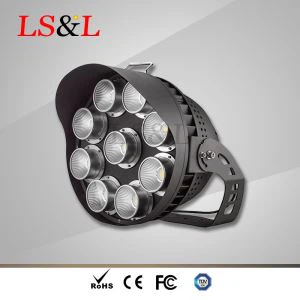
Having worked in the foreign-trade lighting export sector for over a decade, I frequently hear clients ask when requesting quotes: What is the input voltage range of your L? Can they be connected directly to 380V industrial power? This question may seem simple, yet it directly affects product compatibility across different countries and regions, as well as the practical implementation of industrial-park projects. Today I will clarify the common voltage ranges and the 380V adaptation issue based on real experience.
The most common input voltage for export-oriented LED street lights is AC 100-277V, with some products offering a wider 100-305V range. This coverage basically meets the mains standards of most countries worldwide, including 110-120V in North America and 220-240V in Europe and China. There are also narrow-voltage versions designed for specific markets, such as 200-240V only. Long-tail keywords clients often search, such as "wide-voltage LED street light input range" and "voltage adaptation for industrial-park street lights," all focus on whether the product can run stably on the local grid.
Can It Adapt Directly to 380V Industrial Power?
Standard single-phase LED drivers generally cannot be connected directly to 380V. In industrial settings, 380V is usually three-phase power, while most LED street-light drivers are designed for single-phase input. Forcing a connection can damage the driver at best or cause complete luminaire failure at worst. To adapt to 380V, there are typically two approaches: one is to select drivers specially designed for high-voltage input (for example, 277-480V wide-voltage models); the other is to use a transformer or a three-phase-to-single-phase solution to step the voltage down to an acceptable range. In industrial parks or factory projects, power conditions are often complex, so confirming the voltage type in advance is essential. This is exactly why we emphasize "Strict quality control LED engineering lighting"-rigorous quality control from driver selection and safety certification through to full-luminaire withstand-voltage testing ensures stable and reliable operation within the rated voltage range.
Practical Value of Wide-Voltage Design
Voltage fluctuation conditions vary greatly across different export markets. In some regions, the grid is unstable, with voltage rising and falling unexpectedly. Wide-voltage drivers can maintain stable light output and power under larger fluctuations, reducing failures caused by abnormal voltage. For traders and project contractors, stocking one wide-voltage product can cover more countries and lower inventory risk. At the same time, the power factor, harmonics, and surge-protection capability of a quality driver also directly affect long-term operational safety.
In years of foreign-trade work, I have seen many cases where voltage mismatch prevented on-site installation. I recommend that clients clearly confirm the local voltage standard and whether 380V three-phase power is required before placing an order, and ask suppliers for the driver specification sheet and safety certification documents. A strict quality-control system ensures proper voltage adaptability and protection functions, avoiding the problem of "rated wide voltage but poor actual interference resistance."
is 100-277V or 100-305V. Standard products cannot be connected directly to 380V industrial power and require dedicated high-voltage drivers or additional voltage-transformation solutions. Choosing the correct voltage range is the foundation for smooth project implementation.
undergo rigorous testing for input-voltage adaptability, driver stability, and overall reliability, and have received consistent positive feedback from markets in multiple countries. If you are confirming voltage compatibility or looking for an LED street-light solution suitable for industrial parks, please contact us directly for detailed parameters and sample support.